Tag Archives: Exchange 2013

Exchange Server 2013 CU7

On Tuesday December 9, 2014 Microsoft released Exchange Server 2013 Cumulative Update 7 and the UM Language Packs for Cumulative Update 7, 105 days after the release of the previous CU6 update. This release is a little overdue because of a last minute issue that was found moments before the original release date of CU7. As long as it improves the quality of the release this shouldn’t be a problem though.

CU7 contains fixes for issues reported by customers, including the Russian Time Zone issue and fixes for issues identified in MS14-075. Updates for MS14-075 are also available for Exchange Server 2013 Service Pack 1 and Exchange Server 2013 Cumulative Update 6. Because of the Microsoft (N-1) support policy this hotfix won’t be available for CU5.

Continue reading Exchange Server 2013 CU7

Health Manager does not start on Exchange 2013 Edge Transport Server

After installing an Exchange 2013 Edge Transport Server (CU6) I noticed the Microsoft Exchange Health Manager was not running. When trying to start this service the following error occurred:

Windows could not start the Microsoft Exchange Health Manager service on Local Computer.

Error 1075: The dependency service does not exist or has been marked for deletion.

image

Continue reading Health Manager does not start on Exchange 2013 Edge Transport Server

Cluster Administrative Access Point and Database Availability Group

One of the new features in Windows Server 2012 R2 to decrease complexity is the so called Active Directory detached cluster. This is a regular Failover Cluster, but without a computer account in Active Directory. So, when deploying the Failover Cluster there’s no need to pre-create the Computer Name Object (CNO) anymore, but please note that the individual Cluster nodes still need to be a member of the Active Directory domain though.

Since the CNO is no longer available in an Active Directory detached cluster, the Cluster Administrative Access Point (CAAP) is not available either and in turn this cluster AAP was used by the Failover Cluster Management to access and manage the cluster. Since the cluster AAP is no longer available this is also referred to as an AAP-less, cluster AAP-less or CAAP-less cluster.

Continue reading Cluster Administrative Access Point and Database Availability Group

How to change the Postmaster address in Exchange 2013

While testing mail flow I noticed that when an NDR was sent out by my Exchange 2013 the default postmaster account was used, with the default domain, i.e. postmaster@contoso.local (I use a .local TLD on my Active Directory domain) instead of a regular and routable SMTP domain.

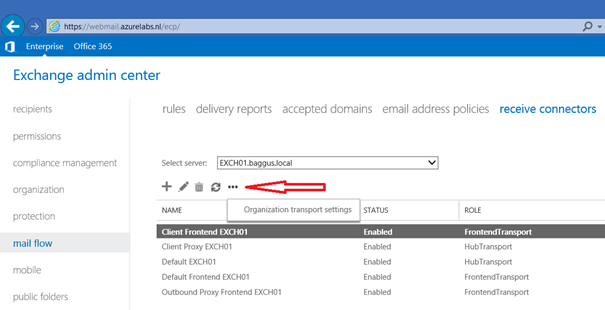
To change this you can open the Exchange Admin Center, navigate to Mail Flow | Receive Connectors and click the more options (the three dots) and select Organization Transport Settings as shown in the following figure.

image

Continue reading How to change the Postmaster address in Exchange 2013